25 June 2026
Navigating Change via Tensions: From Episodic Events to Continuous Transformation
Π The World is Speeding Up
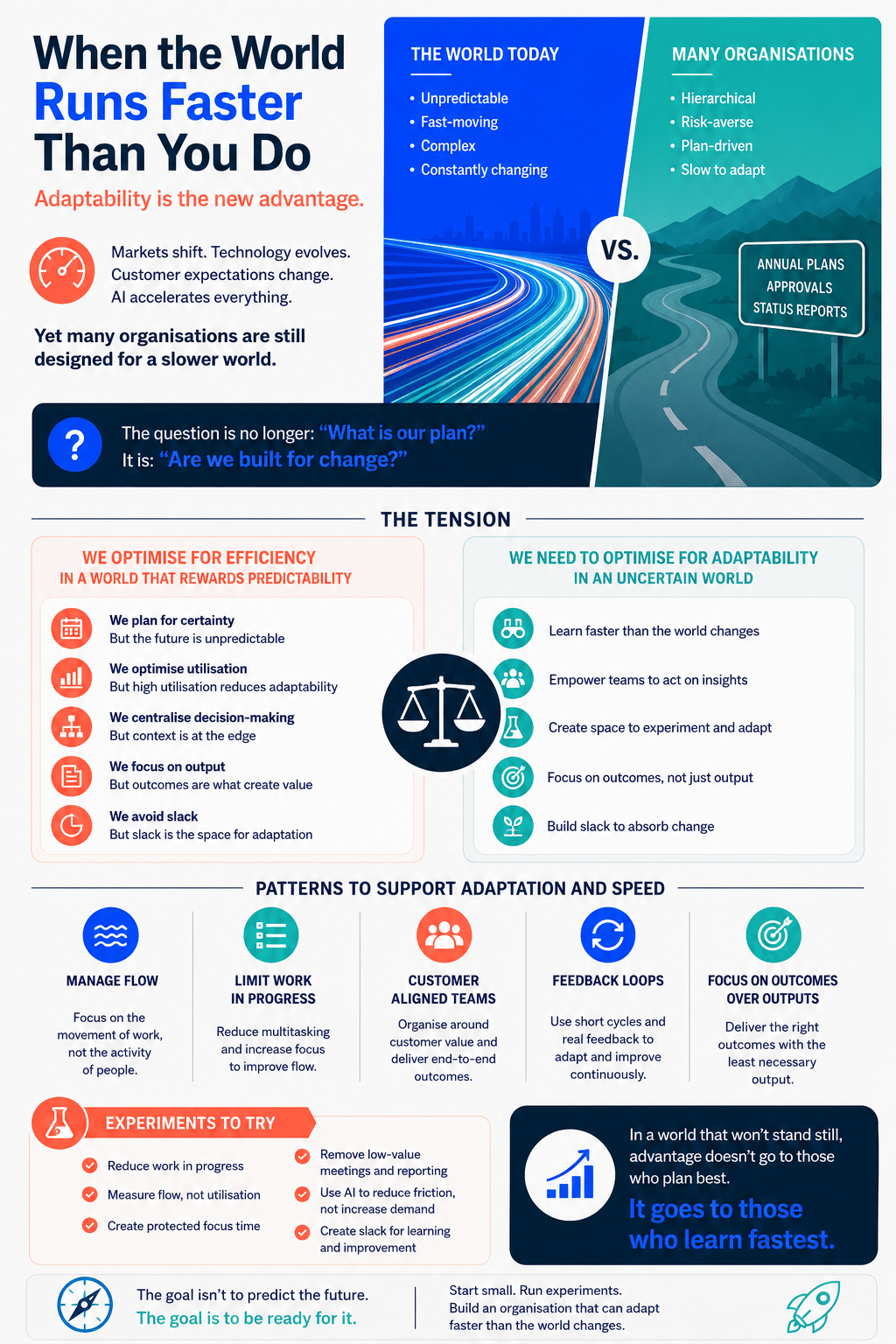
Markets shift overnight. New technologies emerge every month. Customer expectations evolve constantly. And now AI is accelerating the pace of change even further.
Yet many organisations still operate as if the world moves at yesterday’s speed.
We respond to uncertainty by adding more planning, more governance, more approvals, and more process. We create detailed roadmaps and annual plans that assume we can predict what customers will need months or years in advance.
But what if the problem isn’t our ability to plan?
What if the problem is believing that we can know what matters in advance?
Π The New Competitive Advantage
For decades, organisations succeeded by optimising for efficiency, scale, and predictability.
Today, those same strengths can become weaknesses.
When change is constant, the organisations that thrive are not necessarily the biggest or the most efficient. They are the ones that can learn, adapt, and respond faster than the world around them.
The question leaders need to ask is no longer:
“What is our plan?”
It is:
“Are we built for change?”
Π Why We Fall Behind
Most organisations are still designed for a world of relative certainty.
- Decision-making sits at the top.
- Funding is allocated annually.
- Success is measured by how well people follow the plan.
But when the environment changes faster than the organisation can respond, these structures become constraints.
- Teams wait for approvals.
- Plans become outdated.
- Opportunities pass by.
The issue isn’t that people don’t want to adapt. It’s that the organisation isn’t designed to let them.
Π From Prediction to Learning
Adaptable organisations think differently. They recognise that in complex environments, certainty is an illusion. Instead of trying to predict the future, they focus on learning what matters next.
Planning still matters. But its purpose changes. The goal is no longer to eliminate uncertainty. The goal is to create the conditions to learn.
Π AI Changes the Stakes
AI makes this shift even more urgent.
- Ideas can be generated faster.
- Experiments can be run faster.
- Code can be written faster.
But faster execution does not reduce uncertainty. It amplifies it.
When you can move quickly, you can also move in the wrong direction more quickly.
The bottleneck is no longer execution.
It is learning what matters.
The organisations that gain advantage from AI won’t be the ones that generate the most output. They’ll be the ones that shorten the distance between insight and action.
Ask yourself
- Where are we optimising for control instead of adaptability?
- What decisions could be moved closer to the work?
- What would need to change for planning to be a continuous activity instead of an annual event?
Because in a world that won’t stand still, advantage doesn’t go to those who plan best.
It goes to those who learn fastest.
Read Mark’s full article in the Business Coaching Magazine
Π Ready to change how you do change?
📢 Book a conversation. Let’s discuss how we can help you bring about sustainable change.
💡 Because enterprise agility is like fitness, you have to keep working at it, otherwise you get fat.
Develop Your Skills
As a leader in an organisation develop your Agile Leadership skills with our over-arching Agile Leadership training.
If you would like support in building high-performing teams consider our Consulting Services, we can put together a programme for team development designed specifically for your teams and organisation. Reach out today to discuss any support that you need.


