Part 1 – Product Thinking in the Age of AI
Chapter 2
Human Creativity First
In my twenty years of experience in building, coaching and guiding organisations to understand and deliver value, the question of digital tooling has always come into play. During my time at the BBC, starting in 2009, we used Jira to capture product backlog items primarily as user stories. While there was a clear need to maintain a digital format for the creative work, we would always ensure the creative work came first. Over the years, I settled on five simple rules to ensure we got the most out of our sessions:
- Bringing People Together
- Work Across Boundaries
- Focus on Outcomes
- Make Work Visible
- Understand Before You Solve
Bringing People Together
For each product ideation session, I ensure all relevant stakeholders are invited. I call these ‘events’ on purpose. Think about it, when was the last time you attended an event? A conference or concert. How did that make you feel? What compelled you to join the event?
Words resonate. And using the word event, invokes a certain curiosity among stakeholders. In reality, that’s exactly what you’re offering. It’s not a meeting, not only a workshop, but something much more profound in its intent and richer in outcomes. You will always have sceptics, but they soon come around when they see the value of such sessions.
On one occasion, I recall an active event with multiple stakeholders engaged and collaborating around a product idea. One person opened the door right in the middle of the energetic discussion. The door opening created that Jukebox moment. The busy hum of the workshop slowed to an eventual halt, and a person peered their head around the door. All eyes locked onto this individual who said, “This is a very expensive meeting”. And with that said, closed the door. The attendees resumed their energetic conversations as if nothing had happened. He had a point. Having that many people meeting in one room had a cost. However, the cost should not be considered in isolation. We want to ensure a return on our investment. Bringing people together aligns common understanding and creates clarity quickly. In doing so, it reduces waste and avoids unnecessary meetings.
The session aims to bring as many stakeholders as possible into one room. The reason is simple. Group collaboration, when well structured, is far more effective than a series of smaller, fragmented conversations typically held during formal meetings. Group collaboration involving stakeholders from different departments is more effective.
Working across boundaries allows different perspectives to surface early. It creates space for deeper reflection and more critical thinking, as ideas are shared, challenged, and built upon in real time. It also strengthens relationships. People begin to understand each other’s context, which improves alignment and, over time, builds trust.
There is also a human element to this. Bringing people together in a shared environment creates a sense of involvement and belonging. Creating a sense of belonging not only improves the quality of the work but also supports well-being. People feel part of something, rather than working in isolation. When done well, this approach reduces misalignment, avoids rework, and leads to more considered outcomes.
The group of people in the room has a rare opportunity to move toward deep discussions on a single, focused topic. And it is often the case that the group in the room have never spoken in much detail, if at all. You know who they are. You have seen them before. Interactions before this meeting were nothing more than polite corridor exchanges. Now the very same stakeholders are deep in conversation, reflecting on ideas and driving towards a common goal.
Focus On Outcomes
While events offer an innovative way to bring people together, there is always a real risk that the group can drift off into misaligned topics, which can further create division and conflict. That is why it is useful to facilitate the session professionally using tried-and-tested techniques. In order to facilitate well, you essentially have three options:
1. You are fortunate to have a Scrum Master, an Agile Coach, or a role of that type which lends its accountabilities to facilitation. People in these roles have the expertise and flair to bring people together, clearly define expectations, and execute the session flawlessly to achieve the expected outcomes. They also often have experience adjusting the session’s flow based on the group’s reception, ensuring maximum value is achieved.
2. The second is that you invest in a one-time facilitator, a professional facilitator who will run the session and focus on clear outcomes. Having experienced this firsthand, it is useful, but not without its challenges.
3. The third option is to learn the skills to be a great facilitator. This is possible, of course, but I would recommend against it given the dilution of your role. In that session, you are not there to be the room facilitator, offering instructions on the agenda, what they will do next, and what outcomes you expect. Your role is a facilitative leader, and in that space, you walk the group, have discussions, reflect with your stakeholders, and ensure that the outcome is focused, guided, and properly ushered. This is a very specific role, built for a Product Owner.
Your session should be aligned with outcomes. Outcomes are defined as value-focused actions or steps the user takes that demonstrate meaningful behaviour change.
Through outcomes, the stakeholders focus on actionable insights. That is to say, the session ends with closure, and stakeholders know their role in the bigger picture.
Make Work Visible
Visualising work with practical hands-on tools boosts group collaboration and understanding, and creates a sense of connection that would not otherwise exist. While ensuring a digital outlet is available to capture session outcomes, creating a collaborative environment through tools such as index cards and post-it notes is preferable initially.
Understand Before You Solve
A key theme that persists throughout the workshop is the participants’ understanding of what they need to do to succeed. On what goals they should be focused and what possible outcomes they will need to work towards. The intention is not to force a specific action or define a personal solution. Rather, the intention is to get stakeholders to consider a range of options related to the need, problem, or opportunity.
Through doing so, the stakeholders spend a specific amount of time understanding and diverging in the problem space before converging on outcomes. They will begin to make this way of thinking a habit, rather than rushing to solutions. Think about it for a moment: how many times have your stakeholders not only identified the need, problem, or opportunity, but also offered the solution? Once a solution is offered too early, everything else is off the table. Do your best to stay in the ‘what’ space as long as possible, diverge, and ensure stakeholders understand the problem before they solve it. Getting into the habit of describing your need, problem, or opportunity first will help improve your outcomes during vibe coding and AI-assisted programming experiments.
The above are the principles. They cover the intent, offering many ways to fulfil these principles through actionable techniques. The intention here is not to provide a how-to guide, but to offer a means of critically assessing the best way to handle stakeholders within your organisation.
These principles do not live in isolation but instead work seamlessly with a product discovery flow. Below is a baseline flow I have settled on to start the product discovery process. People have offered feedback, both within the organisation and in courses, that they do not start with the vision but instead move to the target market after finessing the idea. Doing so is fine and illustrates that this flow is not set in stone, but it provides one that you may wish to use, or not, based on your circumstances. Below is a short description of each area. Further reading and/or attending the course are encouraged to gain hands-on experience applying the techniques, should you lack experience.
Vision (Product Goal)
The vision sets direction. It defines what you are trying to achieve and why it matters. A clear vision creates alignment across stakeholders and provides a reference point for decision-making. Without it, stakeholders and teams tend to default to activity rather than meaningful progress.
Stakeholders Activities
Stakeholders shape the product, whether intentionally or not. They have a vested interest in the product’s outcome. A vested interest could be a functional need, such as a customer, or a non-functional need, for example, service delivery or a legal requirement. Identifying and mapping them early helps surface expectations, influences, and potential tensions. Working in this way allows for better alignment and reduces the risk of conflicting priorities emerging later.
Target Market
Defining the target market focuses your thinking. It is not about everyone who could use the product, but those who will benefit most. Clarity here enables more meaningful conversations around needs, problems, and opportunities.
Product-Market Fit
Product-market fit is about aligning what you are building with what people actually need. It is not assumed, it is explored. At this stage, the focus is on understanding whether the product idea genuinely addresses a real problem or opportunity in a meaningful way. Assessing product-market fit alignment is a constant theme throughout the process and a distinct step in its own right.
Behaviour / Metrics
Outcomes are reflected through customer behaviour. The focus here is on identifying what meaningful change looks like and how to observe it. Metrics should support this, providing signals that help you understand whether progress is being made. Many techniques and frameworks exist to measure changes in behaviour.
Hypothesis
A hypothesis makes your thinking explicit. It links what you believe to what you expect to see. By defining this clearly, you create something that can be tested, challenged, and refined through experimentation. You build a hypothesis through a statement. The statement might include what you believe will happen, for whom, the outcome you expect to see and how you expect to measure it. The intention is to focus on speed. Think of it as build-measure-learn as quickly as possible.
Backlog → Execution
Once there is enough confidence, ideas begin to take shape as work. The backlog translates thinking into actionable steps, and execution brings those steps to life. It is not the end of discovery, but a continuation of learning through doing. Each iteration and experiment we run gives us confidence in market fit and yields a return on investment.
As mentioned, the above product discovery approach is by no means set in stone. Instead, it is intended as a starting point, with which you are encouraged to experiment both in how you experience the flow and in the techniques that can be applied at each step.
In each step, use this model to ensure you capture the date and information in the best possible way:
This model ensures that an iterative, incremental theme is present in your product discovery flow, regardless of how you implement the activities.
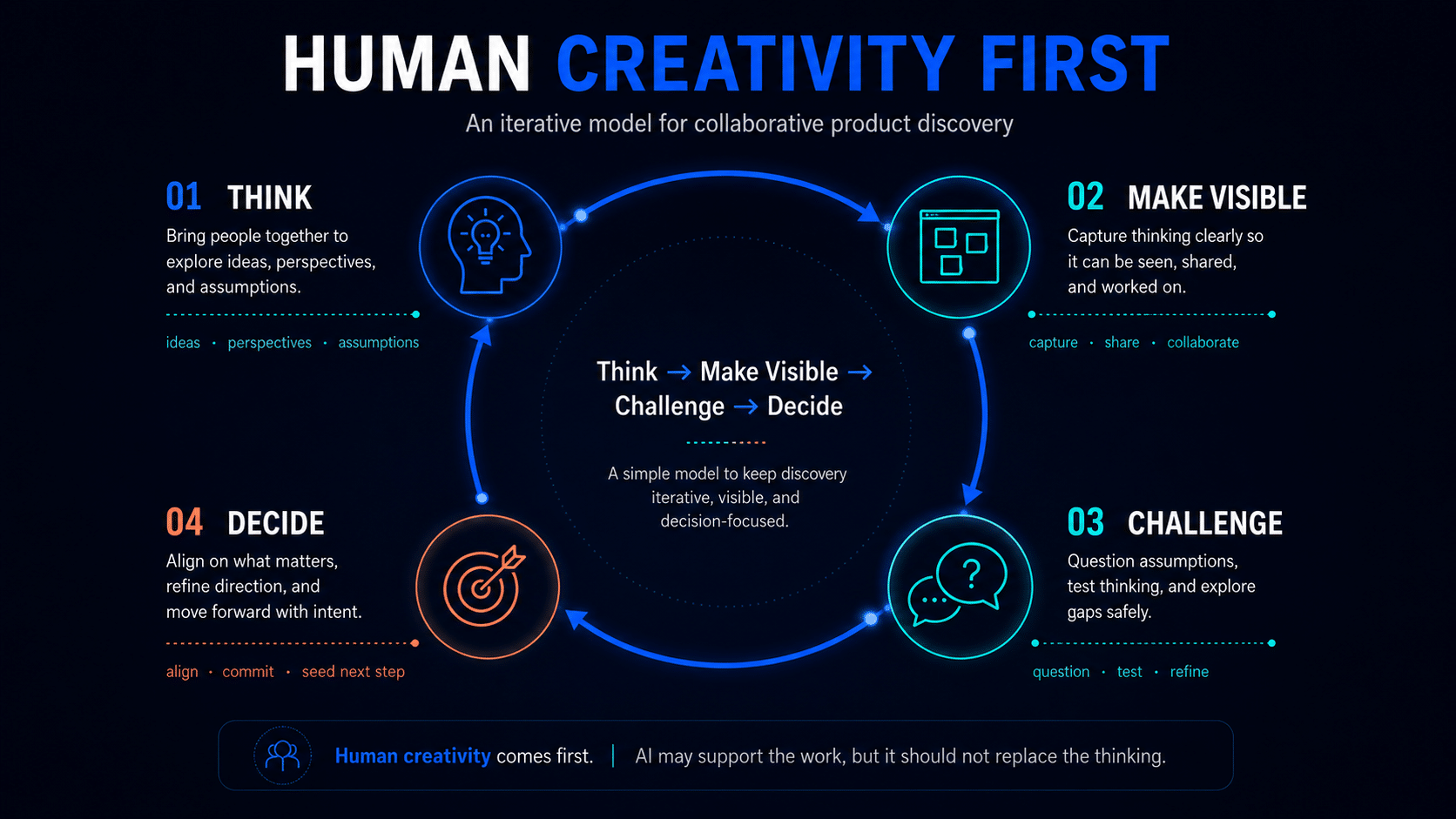
Think
Bring people together to explore ideas, perspectives, and assumptions. Create an environment that provides a safe place to explore ideas.
Make Visible
Capture thinking clearly so it can be seen, shared, and worked on. This could be a group session, either in person or online, using collaboration tools.
Challenge
Question assumptions, test thinking, and explore gaps. Create an environment where people can be challenged safely, and the collective outcome is always focused on the end goal.
Decide
Align on what matters, refine direction, and move forward with intent. Always make sure you close at a point of agreement and use the information to seed the next part.
The purpose of this section of the guide is to put human creativity first before you consider any AI-related tooling. The risk posed by the advent of this new technology is that humans tend to offload not only the time-intensive data-alignment part of their work but also creative tasks. I believe that AI is no match for human creativity. At least not yet. Human beings draw on a multitude of lived experiences at any one time. Think for a moment, how did you feel when you realised you potentially had a great idea for a product? What did you take away from a lived experience when you saw key stakeholders connect with that idea? How does that shape your thinking about the needs your product could fulfil? What problem could your product solve, or what opportunities can your product realise? An AI can simulate this, but I don’t believe it could make those deeper connections you, as a human being, can. Bringing your stakeholders along for this journey creates a collective human intelligence and experience that, in my opinion, is unique and unmatched.
It’s quite simple. Human creativity first, AI second.
What’s Next – Coaching Reflection
- Where in your discovery process do you rely too heavily on tools?
- What thinking should happen before AI enters the conversation?
- How do you encourage stakeholder collaboration?
Π Ready to change how you do change?
📢 Book a conversation. Let’s discuss how we can help you bring about sustainable change.
💡 Because enterprise agility is like fitness, you have to keep working at it, otherwise you get fat.
Develop Your Skills
As a leader in an organisation develop your Agile Leadership skills with our over-arching Agile Leadership training.
If you would like support in building high-performing teams consider our Consulting Services, we can put together a programme for team development designed specifically for your teams and organisation. Reach out today to discuss any support that you need.
About The Author:
For me, organisational change isn’t just about adopting better practices; it’s about challenging deep-rooted beliefs and shifting how people and organisations think, feel, and work. In today’s environment, that also means rethinking how we discover, build, and validate products in the age of AI. True transformation begins on the inside.
I’m an AI Product Specialist, Certified Enterprise Coach (CEC), Certified Scrum Trainer (CST), and ICF-accredited coach with over 19 years of experience helping organisations navigate agile transformation, product development, and leadership evolution. More recently, my work has focused on product discovery and the practical application of AI, supporting Product Owners and leaders in using AI as a thinking partner to explore ideas, challenge assumptions, and accelerate decision-making.
I’ve worked across industries, including government, fintech, aerospace, pharmaceutical, media, and retail, supporting everyone from delivery teams to senior executives. Across these environments, I help organisations move beyond feature-driven delivery toward value-focused product thinking, combining human creativity with AI-enabled experimentation.
Over the past several years, my focus has expanded across the Greater Middle East, where I’ve helped foster thriving Agile communities, led multiple events, and co-founded two regional conferences. Increasingly, these conversations are centred on how organisations can adapt their ways of working to keep pace with rapid technological change.
Whether I’m coaching leaders, training teams, or speaking at conferences, my goal remains the same: to help people let go of outdated, industrial-age thinking and adopt more adaptive, product-led approaches. This includes developing the mindset and skills needed to work effectively with AI, not as a replacement for thinking, but as a partner in discovery and innovation.
If you’re a leader, organisation, or community exploring how to evolve product development and decision-making in the age of AI, let’s connect.



