Part 1 – Product Thinking in the Age of AI
Chapter 1
Making Sense of AI in Product Discovery
AI seems to be everywhere. You can’t open a LinkedIn feed or view an X post without noticing someone sharing the next big shift in AI. Whether it’s how to correctly prompt to get the best out of Claude or OpenAI’s latest model, or pushing the latest approach to build AI agents that will make you six-figure sums. I call this the euphoria phase. It is the phase where FOMO is high, and the pace of change is so fast that we find it difficult to keep up. That is the challenge with the euphoria phase. Things move so quickly that you either hyper-focus or you’re feeling left behind. It reminds me of the dot-com era. The internet was proposed by Bill Gates as “an unavoidable part of life”[7], yet no one was completely sure how it would change the world. We all had opinions for sure, but no one was ever completely confident. You either get behind the camp that disbelieves and gives itself a reason not to engage, or you experiment. Remember the famous Bill Gates Letterman interview [8] when Bill Gates explained the internet to a sceptical audience?[7] The clip is a reminder of how transformative technologies often seem unclear or exaggerated before their value becomes obvious. If you were not in the sceptical camp, your interest aligned with the group that believed a Cambrian shift had already arrived, a shift that meant we need to experiment and learn through it to understand use cases and possibilities. That requires patience. That requires belief.
Let’s consider some statistics that might provide insight into the convergence between the shifts from the dot-com period and what we are living through now.
During the dot-com bubble of the late 1990s, euphoria drove hype about the internet’s possible applications, much like today’s AI adoption surge.[9] Contrary to common belief, actual failure rates were lower than expected, with about 48% of dot-com ventures surviving in the long term, highlighting a period of rapid but selective adoption. During that time, many entrepreneurs and tech enthusiasts were experimenting with the technology, much like people are today. The parallels are strikingly similar to me. People were focused on proving that value would eventually emerge through experimentation with this technology. And it eventually did.
AI adoption today similarly mirrors the dot-com boom’s early euphoria phase around 1997-1998, with rapid enterprise uptake and investments but uneven real-world scaling. Key stats from recent reports highlight parallels in hype, adoption curves, and risks. Global AI use in businesses jumped to 78% in 2024, with generative AI use in at least one business function rising from 33% in 2023 to 71% in 2024. McKinsey’s 2025 State of AI survey found that 88% of organisations now use AI in at least one business function, up from 78% the year before.[10] What will be interesting to observe over the coming years is how and where AI usage changes. Early adopters are already finding that token usage and operating costs can shift quickly as AI moves into key business areas. In some cases, the cost of running AI systems may become significant relative to the the labour savings they were expected to deliver.
Dot-Com Era Parallels
The dot-com and AI eras both began with hype, with infrastructure spending and experimentation at the forefront of this wave of change.[11] The real winners were those who used the technology to create products and business models that solved genuine needs.[12] In such a euphoric period, much like the AI period we are in now, the technology seized the focus alongside the needs.
There are differences for sure, and these are quite clear for obvious reasons. The dot-com era was about access to a new form of communication technology that was fundamental and groundbreaking.[12] A platform technology laying the foundations of the Internet of Things[13] and ultimately the Internet of Value.[14] The products and services that were born out of the enabling technology need no explanation here, but do require stepping back from time to time to acknowledge. While the dot-com era was about internet access and digital presence, AI is about embedding intelligence into workflows, decision-making, and associated products. Another key difference is the speed of change. While uncharted, we will look back at this time of unprecedented change as meteoric.
It feels very similar to the dot-com era, yet during the euphoria phase, we also find people attempting to shoehorn tech to meet problems’ needs and opportunities. We seek product-market fit to align primarily with the needs customers are trying to fulfil, the problems they are trying to solve, or the opportunities we, as entrepreneurs, recognise exist. Every era, age, or whatever you want to classify it as, comes along with a technology so mind-bendingly impressive that we lose sight of what the customer needs and jump straight to the opportunity that may not be there. It happened in the dot-com era, when online was everything, and everyone and every need and problem had a solution. The Internet! Even though we were not sure what the internet really meant at the time, it led to overvalued companies, unclear business cases, and no notable return on investment in those early days.
When foundational technologies emerge, something interesting happens. For a period of time, the normal logic of product development thinking inverts. Instead of beginning with a clearly defined problem, people explore the possibilities of the technology itself; the excitement of what might be possible fuels experimentation. We start asking not only what problem this solves but also what entirely new opportunities this technology creates. It is often the moment when new industries and new ways of creating value begin to emerge.
AI should challenge your thinking, not let you coast.
I started introducing AI into my product classes about one year ago. It was during this time that delegates began discussing AI tooling a bit more than usual. I noticed an uptick in such discussions. Before this, we discussed AI in general as a Cambrian shift that will likely change how we think about delivering value as Product Owners. While useful to frame future-focused Product Ownership, that was as far as it went.
As more and more delegates took an interest, I recognised there was quite a gap in their knowledge of the application. Not only was this evident verbally, but it was also evident through the activities we run in class. Many of my classes focus on creative work. That is to say, delegates spend time reflecting on various concepts before using product development tools and techniques to validate their ideas. During these activities, I would notice LLMs such as Co-Pilot or ChatGPT being used to create outputs. One example is when a team is setting a product goal. We tend to discuss this concept at length before the team can work together creatively to set their own product goal for their newly born idea. I started noticing teams using AI to generate product goals quite quickly, without spending as much time as they should on the creative activity. On further enquiry during reflections, three things became apparent:
- The driver for using AI only came from one or two delegates in the team.
- The other team members, while aware of AI tools, hadn’t really used them.
- The main use of AI by Product Owners was to generate user stories, often without much in the way of creative input first.
And that is where the main issue lies. Product Owners only really use such tools at the lowest potential. Sure, there may be huge time savings, but the lack of creativity means you may end up spending more time in meetings explaining work that isn’t yours. The temptation is too easy, and the unintentional misuse is visible. As Product Owners, we can use AI in much more creative ways than just generating content with no meaning. In this guide, we will present and explore those ways.
The AI Product Discovery Playbook
I reflected on what to include and how to introduce AI tools for Product Owners in my product classes. Two things were clear to me at this point: 1. Product Owners needed guidance on not only what AI is, but also how to use it in a meaningful and practical way. 2. Product Owners were getting lost in the mire of AI information out there right now. Remember, I wrote that AI adoption is in the euphoria phase. There is so much information available that it often gets difficult for me, someone who has maintained a solid awareness of AI concepts and practical tools over the years. A new or aspiring Product Owner is often lost and doesn’t understand the full potential of the technology they are using. Both to help them in their day-to-day business as a Product Owner, but also a way in which AI, in general terms, is impacting both the business and industry in which they exist to deliver value.
It was at this point that I decided to create a simple AI Product Discovery Playbook. The intent was simple. During my advanced product classes, we work on product discovery techniques, which provide a core backbone for a Product Owner to use and adapt to build experiments to test their hypotheses. Product Owners need additional support to understand tools and techniques, from managing stakeholders to product discovery and beyond. The Product Owner must make sense of how to use these tools, what the accountabilities mean, and how to interpret them to build great products. Understanding and applying all of this was challenging enough for Product Owners ten years ago, given the relative technological stability. But as we move into the world of AI full force, I am meeting Product Owners who are increasingly feeling out of their depth. My intention is to avoid this happening.
I find that very few Product Owners I meet have experienced full end-to-end discovery. Product discovery has always been one of the most important, yet often misunderstood, responsibilities of a Product Owner. Too frequently, it is treated as a brief phase at the start of a project, something to complete before the “real work” of delivery begins. In reality, discovery is an ongoing discipline. It is the process of exploring problems, uncovering opportunities, and developing a deeper understanding of the needs we are trying to serve. In my courses, we revisit this idea and examine how modern tools, particularly AI, can help Product Owners think more critically and explore ideas more quickly. Used thoughtfully, AI does not replace discovery; it strengthens it, helping Product Owners challenge assumptions, explore possibilities, and move from an initial idea to a testable hypothesis with far greater clarity.
How to Use the AI Product Discovery Playbook
It is important to note the AI Product Discovery Playbook is not the only approach. I tend to use this in my (level 2) advanced Product Owner classes. The Level 3 Professional Product Owner class uses a product discovery tool I vibe-coded, which provides even more options for AI-driven product discovery. Think of an all-in-one sandbox to start an idea and build a prototype to test your hypothesis with AI stakeholders. More on this in later chapters.
The playbook supports a similar concept but in a much lower-tech setting, yet no less impactful. With the plethora of LLM tools from ChatGPT, Claude, to Co-Pilot, using such tools transactionally is not a major problem for most Product Owners. The challenge is how best to utilise the tools. As mentioned, most Product Owners simply focus on narrow use cases, such as building their backlog, improving this user story, or composing an email to stakeholders about the next backlog refinement session. While perfectly useful, AI models are capable of so much more.
We start at a point where we meet most Product Owners. Managing their product backlog, working closely with stakeholders and their agile teams on an iterative delivery approach. Yet all the while, Product Owners need to be more than just administrators. You own the product, at least one would hope. And in doing so, ownership means growth, development and value. You are tasked with creating opportunities for return on investment. The buck stops with you. Levelling up to product discovery approaches both rapidly increases your failure rate and, hence, your success rate, and helps you learn fast.
Before we begin applying the techniques in the playbook, I will first describe my in-person, collaborative human creativity approach to product discovery that I apply within organisations. It is important to note that there is no single set pathway to product discovery. Most models use a similar approach, and I am sharing what has worked for me over the last two decades or so. That said, what I share here is expected to be adapted and refined for your organisation’s context. Don’t just copy; critically think about what works for you, what does not work for you, and how you might use it differently.
Below is an illustration of my product discovery loop. This can be used with or without AI enabled support.
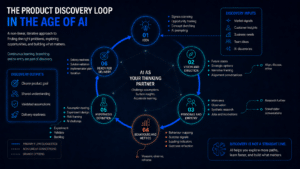
The playbook aims to guide you through an AI-enabled product-discovery approach throughout the course. The broader intent is also for you to use this guide in your own time, on your own product discovery projects. Doing so will create confidence in two ways. First, it will familiarise you with the standard product discovery steps that one might typically take to validate a hypothesis. And two, it will provide you with a learning opportunity to begin experimenting with AI-related tools. Many of you are likely familiar with the standard product discovery approach rather than the AI tooling, although we’ll emphasise both.
Each section in the playbook provides an option to copy and paste standard prompts. These may not perfectly fit your requirements, so it is recommended that you craft your own prompts. A recommendation to seed at this point is always to consider human thinking first. By this, I mean, focus on creative thinking. Ask yourself questions and answer them to ensure you are not biased by the AI’s outputs. My personal experience is that the quality of your outputs will be much improved by controlling the creative narrative. Let the AI build on these ideas with you as your product discovery partner, challenge you and perhaps at a much later point in the conversation, suggest some ideas with which you can consider as part of your overall approach.
As discussed, the human thinking parts may be captured by yourself or collaboratively using tools such as Mural. It goes without saying that during the creative group sessions, you should ensure you use solid facilitation techniques to maximise the quality of your creative work, especially with teams. Considering the approach only adds to the quality of the conversations you will have with your AI. When you have completed the creative work, you can copy this as part of your well-crafted AI prompt. You can read more about the best way to prompt in the appendix at the end of this guidebook.
In the coming chapters, I will share a step-by-step guide on how to create your AI product discovery partner and personas to support you through the discovery process. We’ll use real examples that will give you the ability to critically think through ways you might use your own AI. This guide is not intended to be a follow and copy script as such. The intention is to introduce you to core AI product discovery techniques that you might adapt to your own needs and evolve.
One final thought. In my experience, it is better not to treat AI output as answers. Use the output to build an idea around an informed discussion. This way, rather than outsourcing your creative thinking, you are bouncing ideas around with a thinking partner. It allows your mind to roam and consider future possibilities. You’re not trying to reach a destination. Rather, you’re evolving your ideas towards a future reality.
What’s Next – Coaching Reflection
- When do you ask tools for insights instead of answers?
- How might a discovery partner change how you explore ideas?
- What’s stopping you from adopting AI into your product discovery approach?
- How might you inspect and adapt your ideas based on what you learned?
Footnotes and References:
7 Independent article: The Independent (2021) ‘Bill Gates tried to explain to David Letterman that the internet was more useful than radio or magazines in 1995’. Available at: https://www.independent.co.uk/life-style/bill-gates-internet-david-letterman-interview-radio-magazines-microsoft-a9213991.html (Accessed: 6 May 2026).
8 YouTube video Letterman (1995) ‘Bill Gates explains the Internet to Dave (1995) | Letterman’. YouTube video, 27 November. Available at: https://www.youtube.com/watch?v=fs-YpQj88ew (Accessed: 6 May 2026).
9 Sull, D., Tedlow, R.S. and Rosenbloom, R.S. (2007) ‘Lessons of the last bubble’, strategy+business, 27 February. Available at: https://www.strategy-business.com/article/07102 (Accessed: 6 May 2026).
10 Stanford HAI (2025) The 2025 AI Index Report. Stanford, CA: AI Index Steering Committee, Institute for Human-Centered Artificial Intelligence, Stanford University. Available at: https://hai.stanford.edu/ai-index/2025-ai-index-report (Accessed: 6 May 2026).
McKinsey & Company (2025) The State of AI: Global Survey 2025. Available at: https://www.mckinsey.com/capabilities/quantumblack/our-insights/the-state-of-ai (Accessed: 6 May 2026).
11 Malkiel, B.G. (2020) ‘The dot-com bubble’, in Boom and Bust. Cambridge: Cambridge University Press. Available at: https://www.cambridge.org/core/books/abs/boom-and-bust/dotcom-bubble/690BD009D795B9557E4A9B44A0D40FF9 (Accessed: 13 May 2026).
Chelikavada, A. and Bennett, C.C. (2025) ‘Title of paper’, arXiv preprint arXiv:2509.11982. Available at: https://arxiv.org/abs/2509.11982 (Accessed: 13 May 2026)
12 Stanford HAI (2025) The 2025 AI Index Report. Available at: https://hai.stanford.edu/ai-index/2025-ai-index-report (Accessed: 13 May 2026).
13 IBM (2023) ‘What is the Internet of Things (IoT)?’, IBM. Available at: https://www.ibm.com/think/topics/internet-of-things (Accessed: 13 May 2026).
14 Ripple (2017) ‘The Internet of Value: What it means and how it benefits everyone’. Available at: https://ripple.com/insights/the-internet-of-value-what-it-means-and-how-it-benefits-everyone/ (Accessed: 13 May 2026)
Stanford HAI (2025) The 2025 AI Index Report. Stanford, CA: AI Index Steering Committee, Institute for Human-Centered Artificial Intelligence, StanfordUniversity. Available at: https://hai.stanford.edu/ai-index/2025-ai-index-report (Accessed: 6 May 2026)
Π Ready to change how you do change?
📢 Book a conversation. Let’s discuss how we can help you bring about sustainable change.
💡 Because enterprise agility is like fitness, you have to keep working at it, otherwise you get fat.

Develop Your Skills
As a leader in an organisation develop your Agile Leadership skills with our over-arching Agile Leadership training.
If you would like support in building high-performing teams consider our Consulting Services, we can put together a programme for team development designed specifically for your teams and organisation. Reach out today to discuss any support that you need.
About The Author:
For me, organisational change isn’t just about adopting better practices; it’s about challenging deep-rooted beliefs and shifting how people and organisations think, feel, and work. In today’s environment, that also means rethinking how we discover, build, and validate products in the age of AI. True transformation begins on the inside.
I’m an AI Product Specialist, Certified Enterprise Coach (CEC), Certified Scrum Trainer (CST), and ICF-accredited coach with over 19 years of experience helping organisations navigate agile transformation, product development, and leadership evolution. More recently, my work has focused on product discovery and the practical application of AI, supporting Product Owners and leaders in using AI as a thinking partner to explore ideas, challenge assumptions, and accelerate decision-making.
I’ve worked across industries, including government, fintech, aerospace, pharmaceutical, media, and retail, supporting everyone from delivery teams to senior executives. Across these environments, I help organisations move beyond feature-driven delivery toward value-focused product thinking, combining human creativity with AI-enabled experimentation.
Over the past several years, my focus has expanded across the Greater Middle East, where I’ve helped foster thriving Agile communities, led multiple events, and co-founded two regional conferences. Increasingly, these conversations are centred on how organisations can adapt their ways of working to keep pace with rapid technological change.
Whether I’m coaching leaders, training teams, or speaking at conferences, my goal remains the same: to help people let go of outdated, industrial-age thinking and adopt more adaptive, product-led approaches. This includes developing the mindset and skills needed to work effectively with AI, not as a replacement for thinking, but as a partner in discovery and innovation.
If you’re a leader, organisation, or community exploring how to evolve product development and decision-making in the age of AI, let’s connect.


